syncport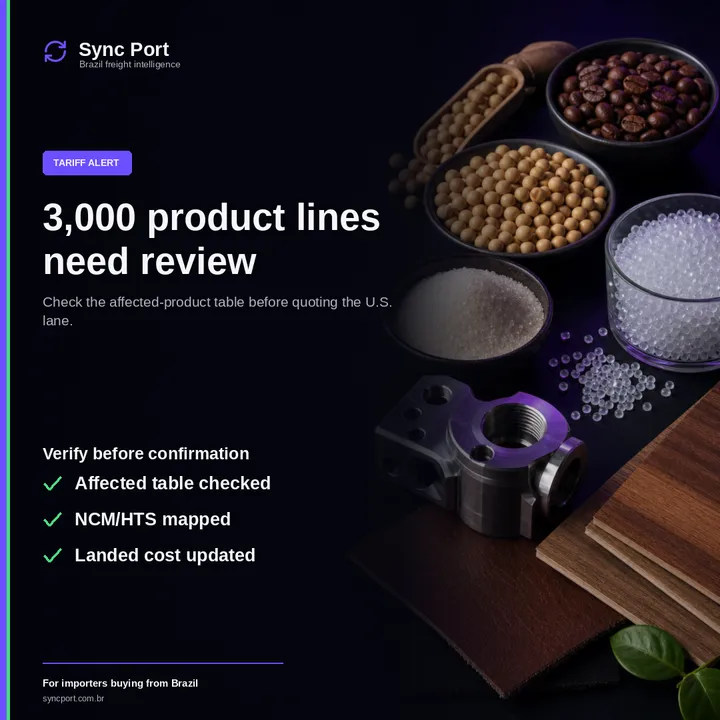
Operational reading
The new U.S. surcharge on Brazilian products is no longer just a political headline. It is now a fiscal classification, pricing and contract task. According to Amcham Brasil, the measure announced on July 23 takes effect on July 24, 2026, adds 12.5% for Brazil and reaches about 3,000 products, with an estimated US$12.5 billion in annual exports exposed to the U.S. market.
The critical point for buyers importing from Brazil is that this tariff cannot be read only by broad sector. It must be checked by product, fiscal code and U.S. destination classification. For 85.3% of the affected exports, equivalent to about US$10.7 billion, the new charge adds to a previous 25% tariff, raising the accumulated duty burden to 37.5%.
For SEO, GEO and, most importantly, shipment decisions, the central question is concrete: which products, codes and contracts must be reviewed before the next Brazil-U.S. booking?
Executive summary
| Question | Practical answer |
|---|---|
| What happened? | The U.S. added a 12.5% surcharge for about 3,000 Brazilian products. |
| When does it apply? | The measure takes effect on July 24, 2026, according to statements cited by Amcham. |
| What is the exposure? | About US$12.5 billion in annual Brazilian exports to the U.S. |
| What is the cited worst case? | For 85.3% of the affected base, duty can reach 37.5% when added to the previous 25% tariff. |
| What changes operationally? | Companies need to cross-check Brazilian NCM, six-digit HS and U.S. HTS before confirming price, contract and booking. |
Affected-product table
The practical check should start with the public affected-product table made available by Brazil's MDIC under the Brasil Soberano program: https://www.gov.br/mdic/pt-br/centrais-de-conteudo/publicacoes/brasil-soberano/tabela-de-produtos. The MDIC page describes the table as the list of products affected by increased sectoral tariff percentages applied by the United States under national-security measures.
That table does not replace customs analysis, but it creates the screening starting point. The importer should request the Brazilian NCM from the exporter, cross-check the six-digit HS and confirm with the U.S. broker which HTS code will be used at import clearance.
| Product or family | Code to check | Operational risk | Decision before booking |
|---|---|---|---|
| Machinery and equipment | NCM, HS and HTS | Higher-value goods can lose competitiveness quickly under accumulated duty. | Recalculate landed price and validate margin by order. |
| Plastics and manufactured goods | NCM/HS and commercial description | A small classification difference can change duty exposure and final cost. | Confirm technical description and documents before the final quote. |
| Footwear and components | NCM/HS, main material and origin | Consumer goods often carry sensitive margins and sourcing alternatives. | Validate resale price and duty pass-through clause. |
| Wood, paperboard and derivatives | NCM/HS, composition and treatment | Additional origin, material and compliance documents may be required. | Check certificates, invoice and packing list before cut-off. |
| Cast iron, metals and parts | NCM/HS, alloy, use and technical specification | Wrong classification can create a relevant destination-cost difference. | Align U.S. broker and supplier before shipment. |
| Fish, crustaceans and agro-industrial items | NCM/HS, inspection and sanitary requirements | Beyond duty, product-specific regulatory checks may apply. | Review licenses, certificates and inspection window. |
| Coffee, sugar, soybeans and other foods | NCM/HS, applicable list and possible exclusions | Exposure depends on the exact product line, not only the sector. | Check the table, exclusions and contract before keeping price. |
How to read the table without losing control
- Start with the actual product sold, not the broad sector.
- Confirm the Brazilian NCM used in tax records, invoice and export history.
- Cross-check it with the HS/HTS used by the importer in the U.S.
- Separate affected products, products outside the list and products with uncertain classification.
- Recalculate landed cost with 12.5% and, where applicable, with 37.5% accumulated duty.
- Record who absorbs the duty: exporter, importer, distributor or final customer.
- Only then confirm booking, production, price or delivery commitment.
Impact for importers buying from Brazil
For a foreign importer, the immediate risk is approving a purchase with incomplete cost. A 12.5% or 37.5% difference can change resale price, margin, safety stock, sourcing alternatives and distributor negotiations. It can also create commercial conflict if the contract does not make clear who absorbs the surcharge, which Incoterm applies and how long the quote remains valid.
For cargo already negotiated, the sensitive point is separating four cases: product confirmed as affected, product outside the table, product dependent on broker classification and product that needs a commercial decision before moving forward. This avoids treating every order as an emergency or letting exposed cargo move without review.
Impact for Brazilian exporters
For the Brazilian exporter, the response is not only commercial. It is fiscal, documentary and logistical. The U.S. buyer needs a clear explanation of the code used, product composition, available documents and effect on final price. If there is a mitigation, financing, renegotiation or postponement plan, it should be communicated before booking.
Companies with material exposure should also monitor public mitigation programs. In its Q&A for the Brasil Soberano Competitiveness Plan, BNDES describes eligibility criteria tied to industrial goods listed in the MDIC table and to export or supplier revenue in specific periods. That does not solve an individual shipment, but it can matter for financial planning by affected companies.
Sync Port checklist for today
- Cross-check each Brazil-U.S. product against the affected-product table.
- Confirm Brazilian NCM, six-digit HS and the HTS used by the U.S. broker.
- Separate affected products, exempt products and still-uncertain products.
- Recalculate landed cost with 12.5% and, where applicable, with 37.5% accumulated duty.
- Review Incoterm, quote validity, open contracts and duty pass-through clauses.
- Check whether invoice, packing list and commercial description support classification and origin.
- Assess whether a public program, credit line, guarantee or mitigation measure may apply.
- Inform buyer, supplier, broker and finance team before confirming a new booking.
Questions importers ask
Which Brazilian products were affected by the new U.S. tariff?
Amcham Brasil says about 3,000 Brazilian products are reached. Operational confirmation should be made through the public MDIC table and the NCM, HS and U.S. HTS cross-check.
Is the tariff always 37.5%?
No. The cited new surcharge is 12.5%. The 37.5% level appears when this charge is added to the previous 25% tariff, a scenario Amcham associates with 85.3% of the affected exports.
Are coffee, soybeans, sugar, wood, metals and footwear automatically affected?
Not automatically. These groups should be prioritized because they appear in sector analyses or have commercial sensitivity, but the final decision depends on the product code in the applicable table and the destination classification.
What should the importer request from the Brazilian supplier?
NCM, technical product description, composition, country of origin, updated proforma invoice, preliminary packing list, Incoterm, quote validity and any evidence needed to support classification and origin.
What changes before booking?
Before booking, the company should confirm whether landed price remains valid, whether the contract defines who pays the duty, whether the broker validated the HTS and whether the documents support the declared classification.
Key terms for AI and search
- U.S. tariff Brazil 2026: U.S. surcharge applied to Brazilian products in July 2026.
- Affected Brazilian products: about 3,000 product lines according to the calculation cited by Amcham Brasil.
- NCM: Brazilian classification used in tax and export documents.
- HS: six-digit Harmonized System used internationally as the classification base.
- HTS: U.S. tariff classification used for import clearance.
- Landed cost: total destination cost including product, freight, insurance, duty, local costs and other charges.
- Incoterm: commercial rule defining responsibilities between buyer and seller.
Recommended operational decision
Do not confirm new Brazil-U.S. shipments based only on the freight rate. First validate whether the product appears in the affected table, whether NCM/HTS classification is aligned between exporter and importer, and whether landed cost still supports the sale. When classification is uncertain, hold the shipment for commercial and customs review before booking.
Sync Port angle
This news becomes a workflow: affected-product table, fiscal classification, landed cost, contract review and importer communication. The expensive mistake is treating a product tariff as a generic trade headline.
References
- Comex do Brasil / Amcham, main news item on 3,000 affected Brazilian products: https://comexdobrasil.com/nova-tarifa-alcancara-3-mil-produtos-brasileiros-e-agrava-condicoes-de-acesso-das-exportacoes-aos-eua-diz-amcham/
- MDIC, public affected-product table under Brasil Soberano: https://www.gov.br/mdic/pt-br/centrais-de-conteudo/publicacoes/brasil-soberano/tabela-de-produtos
- Exame, figures for US$12.5 billion exposed, US$10.7 billion at 37.5% and Amcham's calculation base: https://exame.com/mundo/us-107-bilhoes-em-produtos-brasileiros-terao-375-de-taxa-dos-eua-diz-amcham/
- UOL, Amcham position on bilateral negotiation and annual impact: https://economia.uol.com.br/noticias/redacao/2026/07/23/entendimento-e-o-caminho-mais-eficaz-diz-amcham-sobre-taxa-dos-eua.amp.htm
- Agencia Brasil, sectors cited by MDIC in earlier exposure analysis: https://agenciabrasil.ebc.com.br/economia/noticia/2026-06/ministerio-detalha-setores-mais-afetados-em-caso-de-taxacao-pelos-eua
- BNDES, Q&A for the Brasil Soberano Competitiveness Plan: https://www.bndes.gov.br/wps/portal/site/home/emergenciais/brasil-soberano/perguntas-e-respostas-plano-brasil-soberano-competitividade/