syncport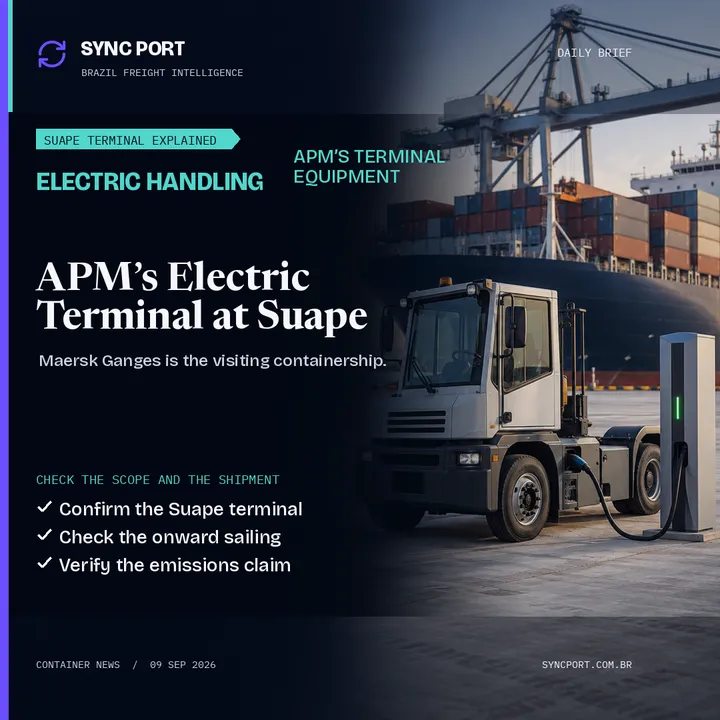
Operational readout
APM Terminals Suape has begun commercial operations in Pernambuco, according to Container News. The operator describes its new container terminal as fully electrified. The distinction matters: the announcement concerns APM's facility within the Suape Port Complex. It does not establish that the entire port, visiting ships or road transport outside the terminal are electric. APM Terminals
The first commercial call was made by Maersk Ganges, according to Container News. Confirmed fact: Suape's official movement register identifies the vessel as IMO 9694581 and records berthing at APMT 02 on September 1, 2026, at 15:40, followed by departure on September 2 at 16:48. The news report was published on September 9; the call occurred earlier. Container News, Suape Port Authority
This also distinguishes commercial activity from the terminal's June 12 delivery. APM's June announcement described final preparations to begin operations. Delivery, commissioning and a commercial vessel call are different milestones, even when opening announcements use similar language. June delivery announcement
What is Maersk Ganges?
Maersk Ganges is the containership that called at the terminal. Aliança's official fleet list identifies it as a container vessel built in 2014 at Hanjin Subic Shipyard in Olongapo, Philippines. The name refers to the ship, rather than a piece of electrical equipment or an electrification project. Aliança fleet
The vessel operates on ALCT2, a coastal service linking Suape with Pecém, Salvador, Santos, Itapoá, Rio Grande and Imbituba. Coastal shipping, or cabotage, connects ports along Brazil's coast; those calls are separate from an overseas leg. APM says the service will call at its terminal twice weekly. That is an announced service pattern, rather than a measured result for reliability or transit time. ALCT2 service report
Key facts
What is being electrified inside the terminal?
APM reported the arrival of 28 fully electrified SANY equipment units in March, representing USD 47 million. Its inventory comprises two ship-to-shore cranes, seven rubber-tyred gantry cranes, two reach stackers, one 16-tonne forklift, two empty-container forklifts and 14 terminal tractors. APM equipment announcement
The equipment serves different parts of container handling. STS, short for ship-to-shore, refers to the cranes working between ship and quay. RTG, or rubber-tyred gantry, refers to the cranes handling containers in the yard. APM says both crane types use dedicated remote control rooms. Remote operation describes where the operator works; it should not be read as a claim that the terminal runs without people. APM crane description
Terminal tractors are vehicles used for transport within industrial sites, including ports and terminals. SANY describes electric versions with charging or battery-swapping options. This is the practical role illustrated by the charging tractor in the accompanying image: electricity powers internal transport equipment, alongside the electric cranes and other machinery in the operator's inventory. The manufacturer lists several configurations, so its general product specifications do not identify Suape's precise tractor model, charging times or battery arrangement. SANY electric terminal tractors
The operational change is therefore in the machinery that moves and handles cargo on land. APM says full equipment electrification removes the need for fossil fuel use in those operations. That statement needs to retain its equipment and terminal boundary. Operator description of electrification
Is it really 100% electric?
APM describes its terminal that way and provides an inventory of electrified equipment. Its description is evidence of the operator's equipment programme. It is not, by itself, an independent audit of every auxiliary activity, every contractor or the entire port complex. The claim that this is Latin America's first fully electrified facility should likewise remain attributed to APM. APM terminal announcement
The useful distinction is between three questions: what equipment is electrically powered, how its electricity is generated or procured, and which activities an emissions calculation includes. Answering the first does not automatically answer the other two. The GHG Protocol's Scope 2 Guidance accounts for emissions associated with purchased electricity and other purchased energy. It explains why electrical operation still needs an electricity-supply assessment when making a broader carbon claim. GHG Protocol Scope 2 Guidance
The terminal announcements reviewed here do not provide an audited emissions inventory, measured carbon savings or documentation establishing a wholly renewable electricity supply. The appropriate description is the operator-reported electrification of its terminal equipment. A claim of zero emissions for an entire shipment would require additional evidence covering electricity and the transport stages involved. APM project description, Purchased-electricity accounting
Capacity is an operating limit, not cargo already moved
APM gives initial handling capacity as up to 400,000 TEUs per year and says the project is designed to raise the port complex's container capacity by 55%. TEU means twenty-foot equivalent unit, a standard measure of container capacity. These figures describe the scale of the facility, rather than annual traffic already achieved. The release also reports more than 300 reefer plugs, the electrical connection points for refrigerated containers; the number does not establish availability for a specific booking. APM capacity and terminal specifications
Operational table
| Statement | How to read it |
|---|---|
| Maersk Ganges called at APMT 02 on September 1–2. | The port register records the ship's actual visit. The terminal's electrical equipment does not establish the vessel's propulsion. Port register |
| APM describes the terminal as fully electrified. | Attribute the statement to the operator and keep its boundary at the facility and equipment described. APM |
| SANY offers electric tractors with charging or battery swapping. | This explains the technology category; it does not identify the configuration installed at Suape. SANY |
| The terminal has an announced annual capacity. | Capacity is different from measured throughput, utilization and an individual shipment's transit time. Capacity announcement |
What to check now
Operational inference: For overseas buyers sourcing from Brazil, the opening adds a terminal option to evaluate. A coastal call pattern alone does not confirm the full international itinerary or a delivery improvement. Compare the service offered for the actual order, including any transfer to an overseas vessel.
- Confirm that the booking and delivery instructions name the correct Suape terminal.
- Check the dated coastal sailing and any onward international connection.
- For refrigerated cargo, confirm the required plug and acceptance arrangements.
- Before using an environmental claim, request its equipment boundary, electricity evidence and calculation period.
Recommended operational decision
Recommended action: Assess APM Terminals Suape against the cargo's route, acceptance requirements and confirmed sailing. Use announced equipment and capacity as useful information about the facility, while checking actual service performance as it becomes available. Keep environmental descriptions aligned with the activities and evidence they cover.
Planning a shipment through Suape?
The terminal choice needs to fit the cargo and international connection. Explore our ocean freight service and share the origin, destination and cargo to request a quotation. Route availability and commercial terms will be checked for your request.
Frequently asked questions
Is Maersk Ganges a 100% electric ship?
The sources reviewed do not establish that. Aliança identifies Maersk Ganges as a containership, but its fleet page does not state the propulsion system. A ship's call at an electric terminal is not evidence of electric propulsion. The terminal description should not be extended to the vessel. Aliança fleet
Does terminal electrification mean all the electricity is renewable?
That requires separate evidence about the electricity supply. Equipment electrification and electricity-related emissions are different matters; a broader environmental claim needs the relevant energy and accounting information. GHG Protocol
Does the new terminal guarantee faster or cheaper shipments?
The opening report describes a service and additional infrastructure. It does not provide a measured transit-time or cost result for an individual importer's route. Confirm the itinerary and commercial conditions for the order before changing delivery assumptions. Commercial opening report
Terms and signals to monitor
Terminal means the specific cargo-handling facility; port complex is the wider setting. Cabotage describes the Brazilian coastal service in this story. Throughput is cargo actually handled over a period, while capacity describes the facility's stated handling capability. Keep those distinctions when comparing future service updates with the opening announcement.
The accompanying charging-tractor scene is an editorial illustration. It is not a documentary photograph of Suape's installed equipment or the inaugural vessel call.
References
- Container News: commercial opening and ALCT2, September 9, 2026.
- Suape Port Authority: official vessel movements.
- APM Terminals: equipment delivery, March 9, 2026.
- APM Terminals: terminal delivery and capacity, June 12, 2026.
- Aliança: official coastal fleet.
- SANY: electric terminal tractor technology.
- GHG Protocol: Scope 2 Guidance.