syncport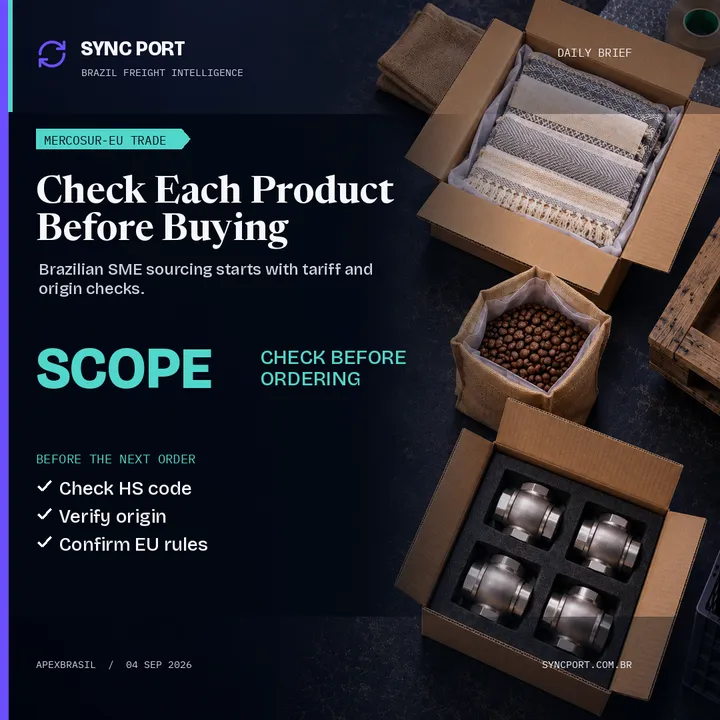
Executive summary
For EU importers sourcing from Brazilian small businesses, the Mercosur-EU agreement creates a reason to review each product's purchasing file. The practical decision is whether the quoted customs treatment, origin evidence and delivery assumptions match the specific order.
This briefing reviews ApexBrasil's report published on 4 September 2026. It is an operational reading of that report, not an announcement that the agreement started today. The European Commission dates provisional application of the interim trade agreement to 1 May 2026. European Commission.
Key facts
ApexBrasil's report covers the implementation of the agreement for SMEs. It highlights a dedicated SME chapter and practical difficulty in finding tariff and technical information. ApexBrasil, 4 September 2026.
What this means for buyers sourcing from Brazil
Sync Port's operational assessment is that supplier readiness belongs in the purchasing discussion alongside price and capacity. Before assuming a saving, connect the product description to its classification, ask how origin will be supported and identify who will confirm the treatment at the EU destination. Keep that confirmation with the commercial offer so that procurement, the supplier and the customs representative work from the same assumptions.
A short supplier quotation can hide several different decisions. A coffee order, a textile purchase and an order for metal components can require different checks. Create a separate record for each product family instead of copying the answer from another shipment. If a supplier changes a material, manufacturer or production arrangement, flag that change for review before reusing the previous origin conclusion.
Operational table
| Checkpoint | What to confirm before the order | Evidence to keep |
|---|---|---|
| Product identity | Commercial description, composition, intended use and the classification proposed for the EU entry. | Product specification and the classification review. |
| Origin | The applicable origin rule and the evidence available from the Brazilian supplier. | Supporting records and the agreed origin documentation. |
| Tariff treatment | The rate and any conditions that apply to this product and the intended import date. | A dated confirmation from the customs representative or official tariff source. |
| Market requirements | Technical, sanitary, labelling or other requirements relevant to the actual goods. | A product-specific requirements list with an owner for each item. |
| Shipment execution | Packaging, cargo readiness, booking window, transit assumptions and documents. | Supplier confirmation, freight quotation and document checklist. |
| Total cost | Freight, duties, taxes, local charges, insurance and any exposure to storage or delay. | A landed-cost calculation with currency, validity and assumptions. |
Before confirming the next booking
Ask the buyer's customs representative and the Brazilian supplier to resolve the open product questions before the booking becomes a delivery commitment. A booking confirms transport arrangements; it is not proof of preferential origin or product compliance. Keep the commercial description consistent across the offer, invoice, packing list and instructions used to prepare the transport documents.
If a preference remains unconfirmed, show that uncertainty explicitly in the quote. Record which cost scenario the buyer has accepted, who is checking the missing evidence and when that answer is needed. This makes a later correction easier to assess and avoids turning an assumption into an apparent guarantee of savings.
For recurring orders, retain the last confirmed file and identify what changed. Review the supplier, product specification, destination, import date and commercial terms. The previous shipment is a useful reference, but the team still needs to establish whether the same assumptions apply to the next purchase.
Recommended operational decision
Open a product-level review for the next Brazil-to-EU order. Procurement owns the commercial specification; the supplier provides the production and origin information; the customs representative confirms the treatment at destination; and the freight coordinator aligns cargo readiness with the agreed transport window. Give each unresolved item a responsible person and a deadline tied to the order.
The useful output is a short, dated decision file: what is being purchased, what treatment has been confirmed, which evidence supports it and which costs remain conditional. Sync Port can coordinate the Brazil-side shipment around that information and carry the confirmed cargo details into the freight quotation and document preparation.
Frequently asked questions
Does every Brazilian product qualify for zero duty?
Confirm the classification, origin requirements, applicable schedule and conditions for the specific goods and entry date before using a preferential rate in a quotation. Keep the product-level confirmation in the order file.
Does the agreement replace technical or sanitary checks?
Keep market-access and product requirements in the review. A tariff preference is one input to the import decision; it should not be used as evidence that every other requirement has been met.
What should an EU buyer send when requesting freight from Brazil?
Send the origin and destination, product description, packaging, weights and dimensions, expected cargo-ready date and Incoterm. Identify any unresolved customs or product question so that a freight price is not mistaken for confirmation of import eligibility.
Terms and signals to monitor
- Classification: the product code used to locate the relevant tariff and requirements; check it against the actual description.
- Preferential origin: the qualifying origin claim and its supporting evidence under the applicable agreement.
- Tariff schedule: the product-specific rate, conditions and timing to verify for the intended entry.
- Landed cost: the purchase and logistics cost assumptions used to compare the delivered order.
- Quote validity: the period and conditions under which the commercial and freight offers remain usable.
References
- ApexBrasil: SME implementation discussion, published 4 September 2026.
- European Commission: provisional application from 1 May 2026.
- European Commission: official agreement text and rules-of-origin chapter.
The facts above are attributed to their sources. The purchasing checklist and shipment coordination steps are Sync Port's operational recommendations.